You are browsing the Blog for Penn State Turfgrass.

Educational Programs: #EXT100Years
Penn State offers several options for an education in turfgrass management: The four-year bachelor's degree program prepares students for a wide variety of careers in the turfgrass industry, and masters and Ph.D. programs offer opportunities for advanced studies. Penn State, in fact, holds the distinction of graduating the first Ph.D. in turfgrass management. Penn State World Campus is another option for students who want to earn credits through distance learning. Penn State's educational programs in turfgrass management have graduated thousands of turf managers who can be found in the industry throughout the world.

Outreach and Cooperative Extension: #EXT100Years
To disseminate up-to-date research results to turfgrass professionals and homeowners, Penn State's turfgrass program has a strong outreach component. Cooperative Extension professionals statewide use workshops, consultations, and publications to cover topics such as diagnosing and managing turf diseases, selecting grass varieties, controlling weeds, and recycling grass clippings. Labs at Penn State are available for turf disease diagnosis and soil testing.
Watch PSU Alums Talk About Managing Sports Turf: #EXT100Years
Watch PSU Alums Talk About Managing Sports Turf

Origins of the Program: #EXT100Years
In 1928, Joseph Valentine, T.L. Gustin, and James Bolton paid a call to Ralph Hetzel, president of The Pennsylvania State College, to ask for research in turfgrass.

Graduating Students Receive PTC Scholarships
The Pennsylvania Turfgrass council has recently announced that graduating students Michael Gurcsik and Nicholas Tristani have been named the 2014 PTC Undergraduate Scholarship recipients.

Looking Back: #EXT100Years
The state of affairs in turfgrass management in the year 1935 was somewhat bleak as the "Great Depression" lasted nearly 15 years. Professor H.B. Musser was in charge of turfgrass research at Penn State. Dr. Fred Grau recieved his Ph.D. from the University of Maryland and was hired as Penn State's first extension agronomist in turf. His responsibilities as turf extension specialist were to evaluate problems in the field and discuss them with research personnel who would then try to solve them.
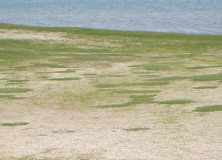
Winterkill Damage on Turfgrass in Central Pennsylvania
The bitter cold and icy conditions during the winter of 2013/14 revealed “spotty” instances of winterkill on golf courses, lawns, and sports turf this spring. While the exact cause is unclear, relatively warm temperatures in the third week of February (highs ranging from 45 to 50°F) may have allowed crown tissues of annual bluegrass and perennial ryegrass to become hydrated and thus, more susceptible to freezing injury. Unfortunately, temperatures dropped to as low as -1°F the following week, and this may have resulted in freezing of crown tissue and plant death. A brief description of the causes and management of turfgrass winterkill are provided in the following paragraphs.
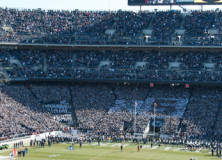
Penn State Program Tries to Prevent Concussions by Examining Surfaces
What does the hardness of the football field have to do with concussions? According to a recent post in USA Football's "From the Field" blog, field density plays a sizable factor in head injuries. In fact, Penn State's Center for Sports Surface Research reported that 10 percent of concussions come from how hard the ground -- or the artificial turf -- is on a football field.

A Master’s Memory: Latshaw Recalls Ramping up The Greens for Tournament
Paul R. Latshaw served as Augusta National Golf Club’s golf course superintendent from 1986 to 1989. The late Joe Duich, the prolific turfgrass professor and researcher from Penn State University, helped recruit Latshaw to Augusta.
Penn State Alum Joins Ecologel Solutions
Ecologel Solutions has expanded their sales team with the recent hire of Regional Sales Managers, Seann Correll, a Penn State Turfgrass four year program alumnus,


